2 - La nef et le vieux clocher
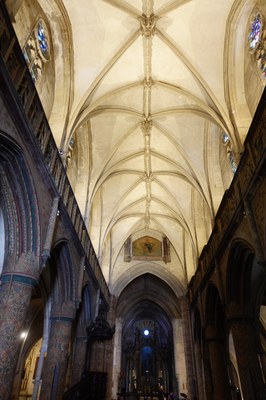
Bâtie sur les ruines de l'ancienne nef romane, la nef actuelle date du XVe siècle. Parmi les originalités architecturales qui intriguent encore les spécialistes, les colonnettes qui entourent les piliers soutiennent les voûtes des bas-côtés et non les piliers eux-mêmes. Autre originalité : les tailloirs (c'est-à-dire la partie supérieure des chapiteaux) sont dépourvus de décor.
Si la construction de la nef date du XVe, sa décoration date quant à elle du XIXe : les colonnes sont peintes de motifs essentiellement végétaux verts et rouges, caractéristiques du style néo-gothique de cette époque. Sous la voûte, une peinture représentant l'Assomption de la Vierge commémore la fin de la guerre de Cent ans et le retour de Cherbourg à la couronne de France. Réalisée en 1864, elle est accompagnée d'une inscription désormais écaillée «Vœu solennel des habitants de Cherbourg en 1450. Délivrance de la domination étrangère » et commémore l'existence du monument Notre-Dame montée.
Built on the ruins of the old Romanesque nave, the current nave dates back to the 15th century. Among the architectural features that still intrigue specialists are the small columns surrounding the pillars, which support the vaults of the side aisles, not the pillars themselves. Another unique feature: the abacuses (i.e., the upper part of the capitals) are devoid of decoration.
While the nave was built in the 15th century, its decoration dates from the 19th century: the columns are painted with mainly green and red plant motifs, characteristic of the neo-Gothic style of that period. Under the vault, a painting depicting the Assumption of the Virgin commemorates the end of the Hundred Years' War and the return of Cherbourg to the French crown. Created in 1864, it is accompanied by a now chipped inscription "Solemn vow of the inhabitants of Cherbourg in 1450. Deliverance from foreign domination" and commemorates the existence of the Notre-Dame montée monument.
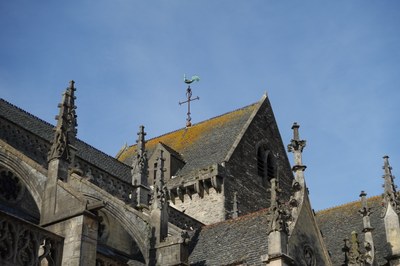
Trapu et rustique, le clocher appartient à la partie la plus ancienne de l'église. Sa construction, partiellement réalisée en opus spicatum (pierres disposées en épi de blé), remonte à la seconde moitié du XIe siècle. Cependant, il ne reste rien de l'époque romane, de nombreuses modifications ayant été apportées au XVe siècle.
Haut d'une quinzaine de mètres, il constitue véritablement le cœur de la basilique, toutes les parties de l'édifice s'y rattachant. Il a abrité des cloches jusqu'en 1830.
A noter, son plan barlong, c'est-à-dire de forme allongée, ici rectangulaire, et dont la longueur est orientée perpendiculairement à la direction principale du bâtiment. Ce plan, répandu à partir du XIIe siècle, permet une meilleure répartition des charges de la voûte.
Stocky and rustic, the bell tower belongs to the oldest part of the church. Its construction, partially made of opus spicatum (stones arranged in a wheat stalk), dates back to the second half of the 11th century. However, nothing remains from the Romanesque period, as numerous modifications were made in the 15th century.
At about fifteen meters high, it truly constitutes the heart of the basilica, with all parts of the building connected to it. It housed bells until 1830.
Note its oblong plan, that is, elongated, here rectangular, whose length is oriented perpendicular to the main direction of the building. This plan, widespread since the 12th century, allows for better distribution of the vault's loads.
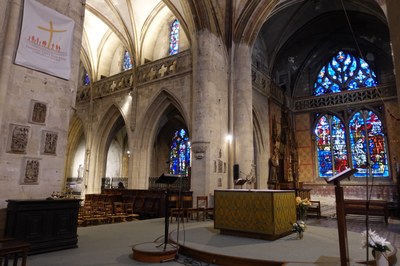
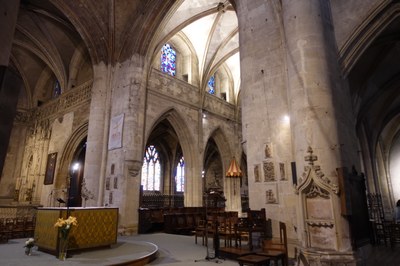
Il ne reste aujourd'hui rien du chœur ni des croisillons du transept, cette nef transversale qui coupe à angle droit la nef principale d'une église lui donnant ainsi la forme symbolique d'une croix, datant de l'époque romane (XIe siècle). Comme pour le vieux clocher, le chœur aurait subi une modernisation intérieure au XVe siècle, attestée par la présence de claires-voies et de voûtes. Ses bas-côtés auraient également été reconstruits et élargis. Les bras du transept ont, eux-aussi, probablement été entièrement reconstruits à cette même période : si les volumes intérieurs du chœur gothique ont vraisemblablement été reproduits lors de la rénovation du XVe siècle, l'aspect extérieur des croisillons a été très modifié au milieu du XIXe siècle. De cette dernière époque date la mise en place du décor flamboyant reproduisant les pinacles et les gargouilles de la nef, ainsi que l'ouverture de grandes verrières à la place des anciennes baies médiévales, plus basses et plus petites.
Nothing remains today of the choir or the transept crossings, this transverse nave which cuts at right angles to the main nave of a church, giving it the symbolic shape of a cross, dating from the Romanesque period (11th century). As with the old bell tower, the choir would have undergone an interior modernization in the 15th century, attested by the presence of clerestories and vaults. Its side aisles would also have been rebuilt and widened. The arms of the transept were also probably entirely rebuilt during this same period: if the interior volumes of the Gothic choir were probably reproduced during the 15th century renovation, the exterior appearance of the crossings was greatly modified in the mid-19th century. From this latter period dates the installation of the flamboyant decoration reproducing the pinnacles and gargoyles of the nave, as well as the opening of large stained glass windows in place of the old medieval bays, which were lower and smaller.